Research

Research Philosophy
Advancing translational equine intestinal research through patient-derived models, rigorous experimental design, and responsible animal use.
The Equine Colitis Lab is founded on the principle that clinically relevant, reproducible research can be advanced while minimizing the use of live horses. Dr. Sheahan became a veterinarian to help horses recover from sickness, and that is reflected in our research philosophy. Our approach prioritizes the development and application of patient-derived intestinal epithelial organoids and two-dimensional monolayers to investigate mechanisms of intestinal disease and evaluate potential diagnostic and therapeutic interventions.
A central component of our research strategy is the establishment of a cryopreserved biobank of intestinal epithelial cultures derived from healthy horses and horses with naturally occurring gastrointestinal disease. Cryopreservation allows cultures from multiple individual horses to be accumulated over time and subsequently expanded and studied in parallel. This approach enables experimental comparisons under standardized conditions, reduces variability associated with separate experimental runs, and facilitates the investigation of interindividual and disease-associated differences without studying live horses.
We emphasize the use of these models as an initial platform for pathogen characterization, mechanistic studies, and evaluation of candidate interventions. By prioritizing in vitro screening and validation, we aim to advance only the most promising candidates to subsequent in vivo investigations when necessary, consistent with the principles of Replacement, Reduction, and Refinement (the 3Rs).
Complementing our experimental models, we are developing a comprehensive biorepository of intestinal tissues, serum, and fecal samples from horses with naturally occurring intestinal disease and healthy controls. At the current time, this includes intestinal tissues from over 200 horses, serum from over 200 horses, and 2000 fecal samples. This resource supports integrated molecular, cellular, and clinical investigations while enabling future studies that may not be anticipated at the time of collection. We seek to maximize the scientific value of these samples through collaborative research and resource sharing.
Our research philosophy emphasizes rigorous experimental design, biological relevance, reproducibility, and the integration of clinical and laboratory-based investigations. We recognize that in vitro models cannot fully reproduce the complexity of the intact intestine or systemic host responses; rather, they provide a powerful platform for mechanistic discovery, hypothesis testing, and prioritization of subsequent investigations.
Our overarching goal is to establish a sustainable, collaborative research infrastructure that accelerates discoveries in equine intestinal disease while reducing reliance on live-animal experimentation.
Research Focus
Investigating the etiology, epithelial pathobiology, and biomarkers of equine intestinal disease through integrated clinical and patient-derived experimental models.
The Equine Colitis Lab investigates the mechanisms underlying intestinal disease in horses, with a particular focus on acute colitis and inflammatory bowel disease. Our research integrates clinical sample collection, molecular approaches, and patient-derived intestinal epithelial models to address critical gaps in disease etiology, pathogenesis, early diagnosis, and prognostication.
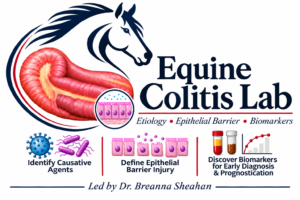
Our program is organized around three complementary research pillars.
Pillar 1: Identification of Novel Etiologic Agents
A substantial proportion of equine intestinal disease cases remain etiologically undifferentiated despite conventional diagnostic testing. We aim to identify and characterize previously unrecognized infectious agents, including enteric viruses, and investigate their potential contributions to intestinal disease.
Our approach integrates molecular pathogen detection with patient-derived intestinal epithelial organoids and monolayers, providing platforms to investigate pathogen–host interactions, epithelial tropism, and mechanisms of infection. These models offer opportunities to evaluate candidate pathogens in an equine-specific cellular environment and investigate their potential role in disease pathogenesis.
Pillar 2: Mechanisms of Intestinal Epithelial Barrier Injury
Disruption of intestinal epithelial integrity is a central feature of many inflammatory and infectious gastrointestinal diseases. We investigate the cellular and molecular mechanisms through which pathogens, microbial products, and inflammatory mediators compromise epithelial barrier function.
Using patient-derived intestinal organoids and differentiated epithelial monolayers, we examine changes in epithelial permeability, tight junction integrity, cellular injury, inflammatory signaling, and epithelial transport processes. Particular interests include pathogen-mediated barrier disruption, including Clostridioides difficile-associated epithelial injury, and mechanisms that contribute to the development and severity of colitis.
These studies seek to identify disease-associated pathways that may represent targets for future interventions aimed at preserving or restoring intestinal barrier function.
Pillar 3: Biomarker Discovery for Early Diagnosis and Prognostication
Current diagnostic and prognostic tools for equine intestinal disease are limited by insufficient gastrointestinal specificity, delayed detection, or limited ability to predict disease severity and clinical outcomes.
We use intestinal tissue-based molecular profiling, including transcriptomic approaches, to identify host-response signatures associated with intestinal inflammation and epithelial injury. Candidate biomarkers are subsequently evaluated in clinically accessible samples, specifically serum and feces, to investigate their potential utility for early disease detection, gastrointestinal specificity, and prediction of complications or negative clinical outcomes.
By integrating tissue-level molecular findings with clinical phenotypes and outcomes, we aim to develop equine-specific biomarkers that improve clinical decision-making and enable earlier intervention.
Long-Term Vision
Our long-term objective is to establish an integrated translational research platform that connects naturally occurring equine intestinal disease with mechanistic investigations in patient-derived experimental models.
By combining etiologic discovery, epithelial pathobiology, and biomarker development, we seek to improve understanding of equine intestinal disease, identify clinically relevant diagnostic and prognostic tools, and prioritize promising interventions for future investigation.
Through this approach, we aim to advance equine gastrointestinal medicine while promoting reproducible, collaborative research and responsible animal use.